
Why Blended Learning Is the Most Efficient Way to Learn Ultrasound
Last updated
Learning musculoskeletal ultrasound is both fascinating and challenging. It requires anatomical knowledge, understanding of ultrasound physics, and — most importantly — many hours of scanning. Anyone who has learned ultrasound knows that real progress happens with the probe in your hand.
At the same time, scanning without a solid theoretical foundation can quickly become confusing. This is exactly why blended learning has become the most efficient way to learn ultrasound.
At SonoSkills, this educational model is central to how our courses are designed: combining high-quality eLearning with intensive hands-on training.
Preparing Before the Hands-On Course
In traditional ultrasound courses, theoretical lectures and hands-on practice compete for the same limited time. Participants often spend a large portion of the course listening to lectures about anatomy, scanning protocols, and ultrasound physics. Blended learning changes this.
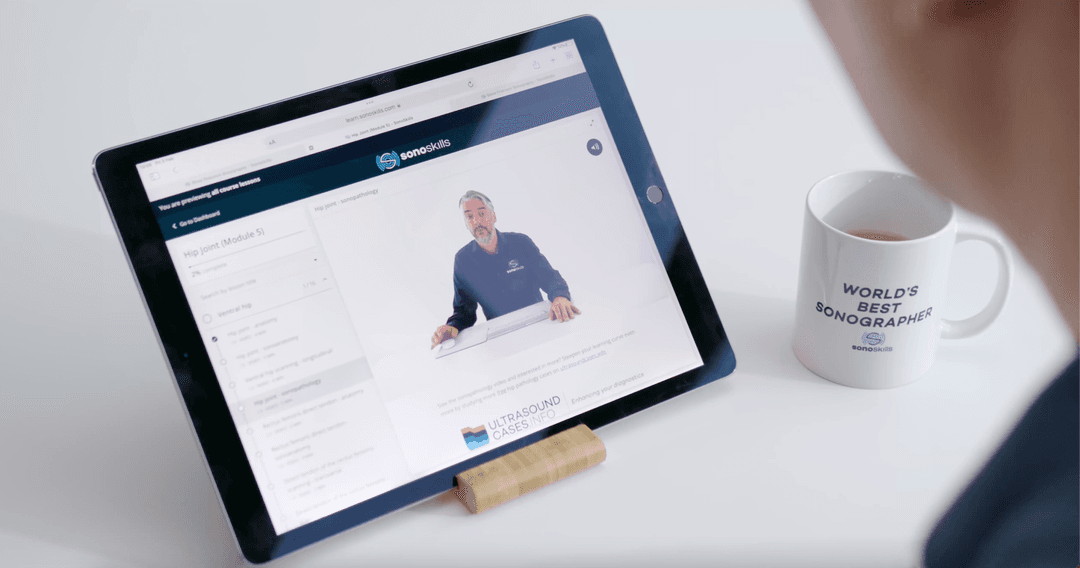
Before attending a hands-on course at SonoSkills, participants receive access to our professional eLearning modules. These are not simple slide recordings but carefully produced educational content with high-quality visuals, structured explanations, and clear scanning protocols.
Participants can study the material in advance and arrive at the course prepared and informed. This allows the hands-on sessions to start at a higher level immediately.
More Time for Hands-On Practice
The biggest advantage of blended learning is simple: more time for scanning.
Ultrasound is a practical skill. Developing probe control, recognising anatomy, and identifying pathology requires repetition and guidance from experienced instructors.
Because the theoretical foundation has already been covered in the eLearning modules, the hands-on course can focus much more on practical scanning. Instructors can go deeper into technique, answer clinical questions, and help participants refine their skills. For ultrasound training, this additional hands-on time is crucial.
Managing the Density of Ultrasound Theory
Ultrasound theory is dense. It involves detailed anatomy, probe positioning, image optimisation, artefacts, scanning protocols and pathology recognition.
If all of this information is presented during a short hands-on course, much of it is inevitably forgotten shortly afterwards.
With blended learning, the theory is stored on the eLearning platform, where participants can review it whenever they need it. Instead of hearing the information once during a lecture, they can revisit the material multiple times. This makes learning more efficient and far more sustainable.
Learning Continues After the Course
One of the most appreciated aspects of the SonoSkills learning model is that participants keep access to the eLearning platform for six months after the course.
This is particularly valuable once clinicians start scanning in their own practice. Questions naturally arise: a structure looks different than expected, a scanning protocol needs refreshing, or a specific pathology needs to be reviewed.
Because the theory remains available online, participants can simply return to the relevant modules whenever needed.
In this way, the learning process continues long after the hands-on course has finished.
A Modern Approach to Ultrasound Education
Ultrasound cannot be mastered in a weekend. It requires preparation, practice and repetition.
Blended learning reflects this reality. By combining high-quality online preparation with intensive hands-on training, it creates a far more efficient learning experience.
At SonoSkills, this approach allows us to focus on what matters most during our courses: helping clinicians develop real scanning skills.
Because in the end, the goal of ultrasound education is not only to understand the theory — but to confidently hold the probe, look at the screen, and know exactly what you are seeing.
Our Blended Learning courses
Want to deepen your ultrasound skills?
Explore our hands-on and online courses in musculoskeletal ultrasound.