
Top 10 Pathologies You Can Detect with MSK Ultrasound
Last updated
Musculoskeletal ultrasound (MSK ultrasound) has evolved into one of the most useful imaging tools in daily musculoskeletal practice. Over the past decade the technique has gained widespread acceptance among radiologists, sports physicians, orthopaedic surgeons and increasingly physiotherapists. The reasons are clear: ultrasound is accessible, dynamic, relatively inexpensive, and does not involve ionising radiation. At the same time modern high-frequency probes allow extremely detailed visualisation of superficial musculoskeletal structures.
Evidence supporting the clinical use of MSK ultrasound continues to grow. The European Society of Musculoskeletal Radiology (ESSR) periodically reviews the literature and publishes consensus guidelines on the clinical indications for musculoskeletal ultrasound. These guidelines highlight a wide range of conditions where ultrasound is considered a first-line imaging modality or equivalent to other imaging techniques. For clinicians using ultrasound in practice, the key question is simple: which pathologies can we reliably identify with MSK ultrasound?
Below is a practical overview of ten common conditions that can be detected with musculoskeletal ultrasound and that have strong or moderate evidence supporting their use in clinical practice.
- Rotator cuff tears
Rotator cuff pathology is one of the most common reasons for shoulder imaging. MSK ultrasound performs very well in detecting both full-thickness and partial-thickness tears of the rotator cuff. Ultrasound can demonstrate tendon discontinuity, retraction, and associated fluid in the subacromial bursa. Numerous studies support ultrasound as a first-line imaging technique for rotator cuff tears, particularly when performed by experienced operators.
- Calcific tendinitis
Calcific tendinitis is frequently seen in the rotator cuff but may also occur in other tendons. On ultrasound the calcium deposits appear as hyperechoic foci within the tendon, often with acoustic shadowing. One advantage of ultrasound is that it allows dynamic assessment and immediate treatment options such as ultrasound-guided lavage or injections.
- Lateral epicondylitis
Lateral epicondylitis, commonly known as tennis elbow, is a classic indication for MSK ultrasound. Ultrasound typically shows tendon thickening, hypoechoic degeneration and sometimes Doppler activity reflecting neovascularisation. The literature shows strong evidence supporting ultrasound for evaluating tendon pathology at the lateral epicondyle.
- Carpal tunnel syndrome
Peripheral nerve imaging is an expanding field within musculoskeletal ultrasound. Carpal tunnel syndrome is one of the most widely studied examples. Ultrasound can demonstrate enlargement of the median nerve, changes in nerve echotexture, and structural causes of compression. These findings correlate well with electrodiagnostic testing and can support the clinical diagnosis.
- De Quervain’s tenosynovitis
De Quervain’s disease affects the tendons of the first dorsal compartment of the wrist. Ultrasound typically shows thickening of the tendon sheath and fluid surrounding the tendons. Because of its high spatial resolution, ultrasound is particularly well suited for detecting tenosynovitis in small tendon compartments of the wrist and hand.
- Baker’s cyst
A Baker’s cyst is a fluid collection in the popliteal fossa, typically arising between the semimembranosus tendon and the medial head of the gastrocnemius muscle. Ultrasound easily detects these cysts and allows differentiation from other masses in the popliteal region. Ultrasound can also be used to guide aspiration if treatment is required.
- Joint effusion and synovitis
Ultrasound is very sensitive for detecting fluid within joints. Small joint effusions can be visualised in the shoulder, elbow, knee, ankle or wrist. In inflammatory conditions ultrasound can also detect synovial hypertrophy and increased vascularity using Doppler imaging. This makes ultrasound useful not only for diagnosis but also for monitoring inflammatory joint diseases.
- Achilles tendinopathy
Achilles tendinopathy is another classic application of musculoskeletal ultrasound. Typical findings include tendon thickening, loss of normal fibrillar structure, and sometimes intratendinous Doppler signal. Ultrasound is particularly valuable because it allows dynamic examination and easy comparison with the contralateral side.
- Plantar fasciitis
Plantar fasciitis is one of the most common causes of heel pain. On ultrasound the plantar fascia typically appears thickened and hypoechoic near its calcaneal insertion. In some cases Doppler signal may indicate active inflammation. Ultrasound is widely used to confirm the diagnosis and to guide therapeutic injections.
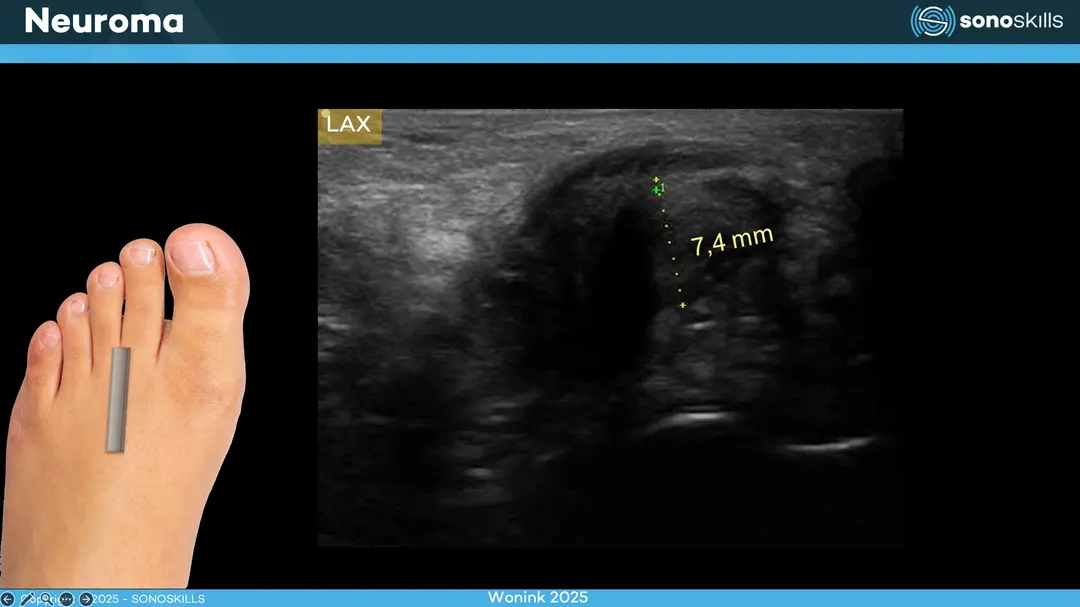
- Morton’s neuroma
Morton’s neuroma is a benign enlargement of the plantar digital nerve usually located between the third and fourth metatarsal heads. Ultrasound can demonstrate a hypoechoic mass in the intermetatarsal space. In experienced hands ultrasound has good diagnostic accuracy and can also be used to guide corticosteroid or alcohol injections.
In summary, musculoskeletal ultrasound has become an essential imaging technique for evaluating many common musculoskeletal disorders. It is particularly well suited for examining superficial structures such as tendons, ligaments, bursae and peripheral nerves. The ESSR consensus guidelines confirm that ultrasound plays a major role in the assessment of degenerative and traumatic tendon disorders as well as several other soft tissue conditions.
For clinicians who integrate ultrasound into their daily practice, the technique offers an important advantage: it combines imaging, clinical examination and interventional procedures in a single session. With appropriate training and experience, MSK ultrasound becomes a powerful extension of the physical examination and a valuable tool in modern musculoskeletal care.
Want to deepen your ultrasound skills?
Explore our hands-on and online courses in musculoskeletal ultrasound.