
5 Reasons to Invest in Your Ultrasound Skills Now
Last updated
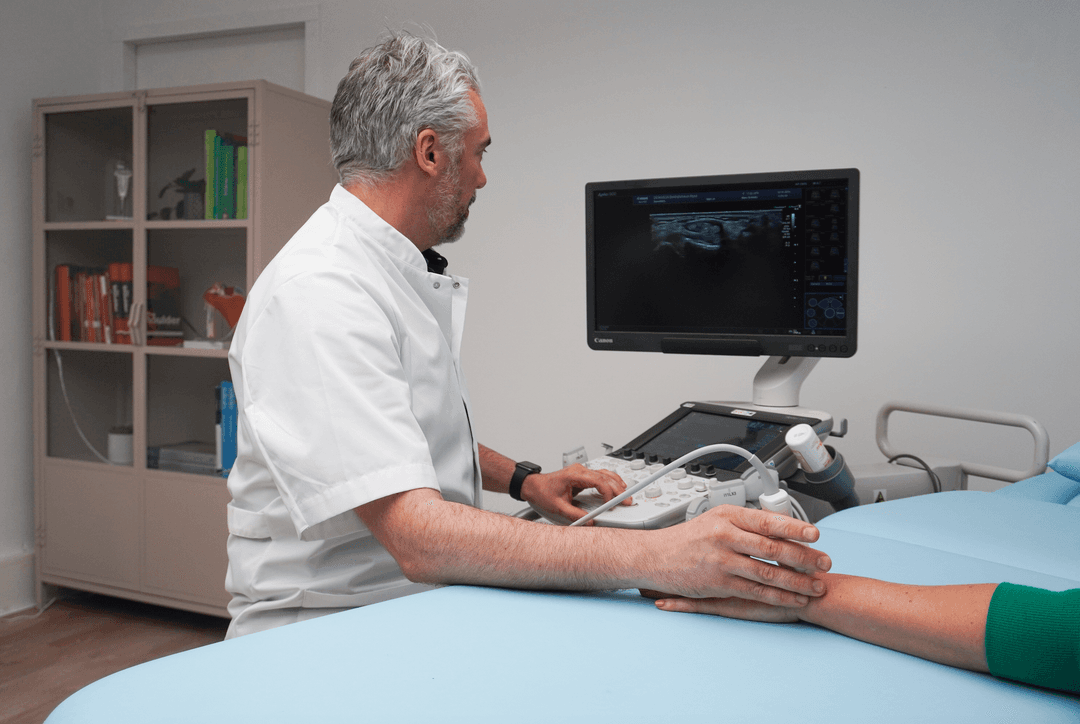
Over the past decade, musculoskeletal ultrasound has evolved from a specialised imaging technique into a widely used diagnostic and interventional tool. What was once mainly the domain of radiology departments is now increasingly used by sports physicians, orthopaedic specialists, and physiotherapists.
The reasons are not difficult to understand. Ultrasound is relatively accessible, provides real-time imaging, and allows clinicians to correlate what they see on the screen directly with the patient sitting in front of them.
Still, many clinicians hesitate. Learning ultrasound requires time, training, and practice. And in busy clinical environments, adding a new skill can feel like adding one more thing to an already full schedule.
Yet there has probably never been a better moment to invest in your ultrasound skills. Below are five reasons why.
- Ultrasound is becoming a core clinical skill
In many areas of medicine, ultrasound is gradually moving from the radiology department to the consultation room. Point-of-care ultrasound is now widely used in emergency medicine, internal medicine, anaesthesiology and critical care.
The same evolution is happening in musculoskeletal medicine. Clinicians increasingly use ultrasound as an extension of the physical examination. Instead of relying solely on palpation and clinical tests, you can actually visualise the relevant structures in real time.
For musculoskeletal clinicians this changes the diagnostic process significantly. When a patient presents with shoulder pain, Achilles complaints or nerve-related symptoms, ultrasound allows you to immediately assess the underlying anatomy.
In other words, ultrasound is slowly becoming less of a “nice extra” and more of a fundamental clinical skill.
- It improves diagnostic confidence
Many musculoskeletal conditions share overlapping symptoms. A patient with lateral elbow pain may have tendinopathy, bursitis, nerve irritation or a combination of these. Clinical tests alone sometimes leave room for doubt.
Ultrasound helps reduce that uncertainty. Visualising tendons, ligaments, bursae or nerves provides valuable information that complements the clinical examination.
Of course, ultrasound does not replace clinical reasoning. But it does strengthen it. Seeing a hypoechoic tendon, a thickened nerve or an inflamed bursa often confirms what you suspected — and occasionally corrects what you thought you knew.
Both outcomes are useful.
- It allows dynamic assessment
One of the unique strengths of ultrasound is that it allows dynamic imaging. Structures can be assessed while they move, while the patient performs specific manoeuvres, or while stress is applied to a joint.
This dynamic capability is particularly valuable in musculoskeletal medicine. Tendon subluxations, nerve instability or impingement phenomena may only become visible when the joint is moving.
Static imaging techniques such as MRI provide excellent anatomical detail, but they cannot always capture functional behaviour in the same way.
Ultrasound therefore adds a dimension that complements other imaging modalities rather than competing with them.
- It opens the door to ultrasound-guided interventions
Another important advantage of ultrasound skills is the possibility to perform image-guided procedures.
Ultrasound-guided injections are increasingly used in musculoskeletal practice because they improve accuracy and safety. Instead of estimating the position of the needle based on anatomical landmarks alone, the clinician can see exactly where the needle is going.
For procedures involving joints, bursae, tendon sheaths or nerves, this level of precision can make a substantial difference.
Many clinicians initially learn ultrasound for diagnostic purposes, only to discover later that image-guided interventions become a natural and highly valuable extension of their practice.
- It enhances your professional development
Finally, investing in ultrasound skills is also an investment in your own professional development.
Learning ultrasound requires a combination of theoretical knowledge, anatomical understanding and practical scanning experience. It is a skill that develops gradually, and most clinicians will recognise the moment when the images on the screen suddenly start to make much more sense than they did during the first training session.
That moment is usually followed by another realisation: the more you scan, the more you see.
For many clinicians, ultrasound becomes one of the most intellectually satisfying aspects of musculoskeletal practice. It adds a visual dimension to clinical reasoning and allows you to observe pathology directly rather than only inferring it. And as a small side benefit, patients tend to find it quite impressive when their clinician can show them what is happening inside their shoulder or ankle in real time.
A final thought
Investing in ultrasound skills requires time and training, but the rewards are substantial. Ultrasound improves diagnostic confidence, supports clinical decision-making, and enables more precise interventions.
For physicians and physiotherapists working in musculoskeletal care, ultrasound is increasingly becoming an essential part of modern clinical practice.
And while mastering ultrasound takes practice, the good news is that the learning process itself is surprisingly enjoyable.
After all, it is not every day that you get to look inside the human body during a consultation — without needing an MRI scanner the size of a small car.
Want to deepen your ultrasound skills?
Explore our hands-on and online courses in musculoskeletal ultrasound.